Showing posts with label Type: Review. Show all posts

18 February, 2015

Red November

Hard times have hit the experiment gnomish submarine Red November.

Everything on the sub is going wrong at once. Fires are burning, the sub is leaking, and critical systems keep failing. Help is on the way, but the gnomish sailors must hold out until the rescuers arrive...


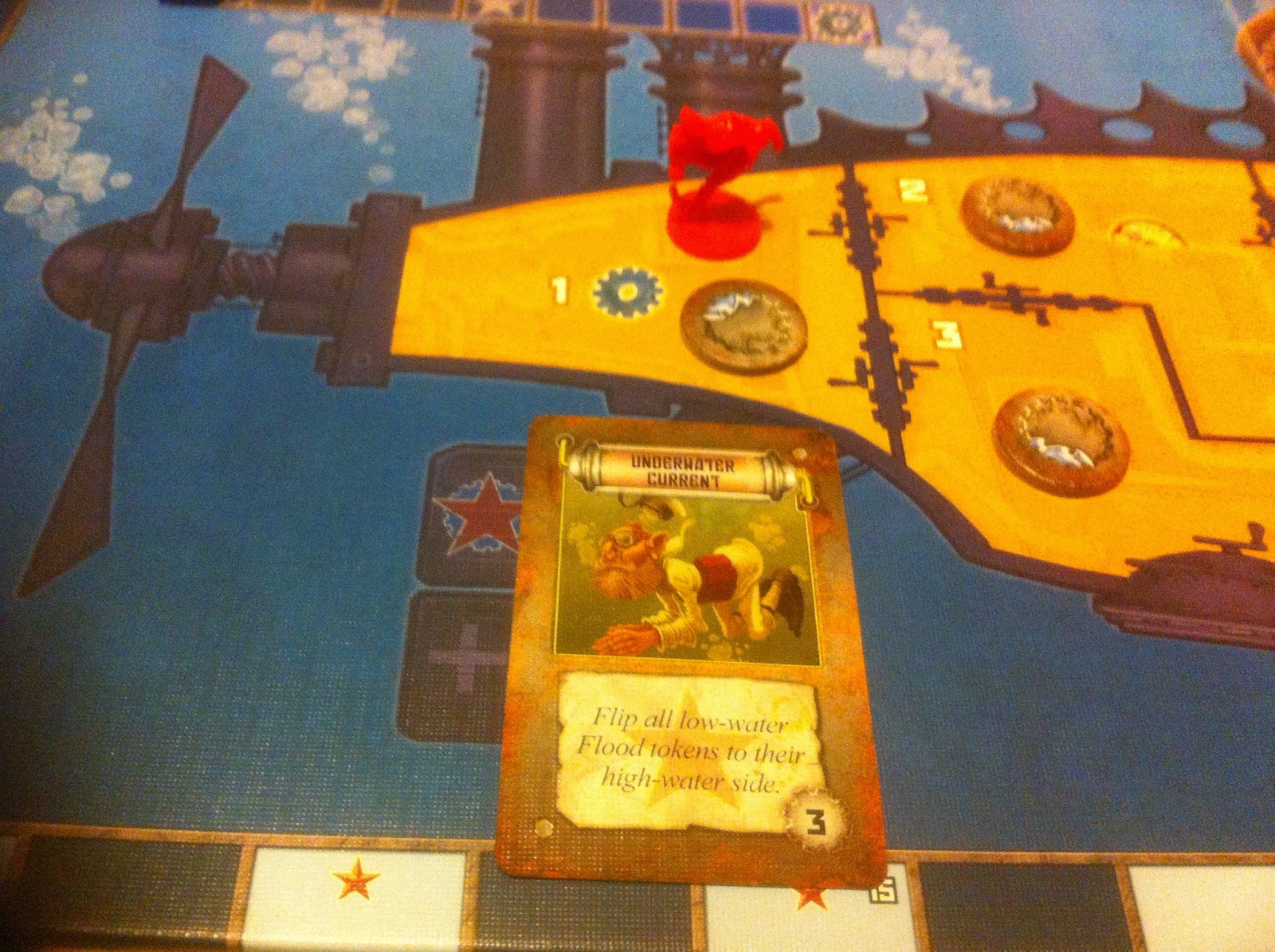
Following the gnomes around is great fun, though below you can see it's all come to a tragic end as an untoward missile launch destroys the submarine


The red gnome is caught in the engine room as it and all
adjacent rooms are flooded  - leaving him with no option but to
wait for help!

With the red gnome saved and with lashings of grog
and a manual, the crisis in the engine room is averted

Multiple gnomes help to clear the way


I really enjoyed the game - actually after running though the rules by myself solo (with three gnomes) I played this with my group down the pub and at Warpcon. A light cooperative game, with a (innovative I think) nice turn order mechanic and with tonnes of trouble to solve, juggling the odds with the time pressure.

09 January, 2015

Shadows over Camelot

As the incarnation of the Knights of the Round Table, you join forces against the game itself in an attempt to protect Camelot.
Your victory hinges on the successful completion of legendary Quests, such as the search for Excalibur, the Holy Grail, or Lancelot's Armor; the tournament against the Black Knight; and numerous wars against the Saxons and Picts.
But beware... all is not as it seems among these noble Knights. One of your number might yet turn out to be a traitor-in-waiting, biding his time while sowing havoc and destruction from the Shadows!


With King Arthur leading Sir Galahad, Sir Tristan and Sir Kay, all of the knights begin by losing life points, discouraged from adding catapults outside Camelot. Sir Galahad and Sir Kay eye up the Saxons and begin to gather resources to prosecute the war against them.

Leaving Camelot on the Quest for Lancelot's armour, Arthur immediately hits trouble as several black cards come out against him. Gaining some help from his fellows, he makes progress, as well as using Merlin to get rid of some opposition.

Sir Tristan advances against the Black Knight. But just as the Saxons are defeated, Guinevere shows up, and all of King Arthur's and Tristan's progress is wasted. Both of these quests are lost in quick succession putting the Round Table in peril.

With the Excalibur Quest close to failure, King Arthur rushes to save it from oblivion.

Returning to the Grail Quest, Galahad and Tristan find that the Dark Forest is blocking their path, and as Desolation pushes back their previous efforts, the Mists of Avalon descend upon the realm.
Seeking to rally themselves against the darkness, and leaving Sir Kay to fight the siege engines arrayed around Camelot, Sir Galahad and Sir Tristan join Arthur to complete his Heroic quest to save Excalibur.

But hope is again snuffed out, as the Grail Quest is lost. Now with six white swords and five black swords on the Round Table, only a mighty quest will bring victory! The knights charge off to fight the Dragon and just when their hope is renewed, Morgan returns to yet again deploy siege engines to bring Camelot's gates crashing down...

Even without a traitor to thwart us, this was a toughie (and obviously we lost!). A great game, that had us looking at the clock to see if we could get a rematch in.

Verdict: 4 stars.


29 April, 2014

Another Salute!

Over the last couple of weeks, various bloggers have been recounting their Salute experiences. I am forced to live vicariously through them. (An expedition to London for the weekend is probably off the agenda for another few years...) I've enjoyed all the eye candy, hopefully you do too!


Shed Wars has only a single photo of this American Civil War game, but between the musket smoke and snake fences it's worth highlighting

A Wargaming Gallimaufry takes a nice photo of this enormous space ship from Dropzone Commander


Steve's Paintingshed highlights this amazing east African battlefield as well as other stuff

Four Colour Super Minis is envious of this early Vietnam game, I'd love this board as well! More photos

Trouble at T'Mill may have hung around the Too Fat Lardies game a bit!

Balkan Gamer gives us a great view of this magnificent Carlist War game

Tarleton's Quarter gets in close on the eastern front

Don't Throw a 1 does us proud with a few nice pics of this 1798 Rebellion game

Big Red Bat Cave shows off this beautiful piece from the Roman Invasion table

I am as enamoured with this artillery train as Steve's Random Musings is

Ancients on the Move showcases the great mix of ancient games on display this year

This Crusading game gets pride of place on History in 1/72, but wait, there's more on Arklow

Lone Warrior is attracted to this In Her Majesty's Name urban board

The Wargame Shed likes this huge D-Day table, and with good reason!

The Angry Lurker likes elephants - who doesn't!


Wargaming Girl has a few photos of a Lord of the Rings game - Orks, Oliphants and Fell Beasts, oh my!

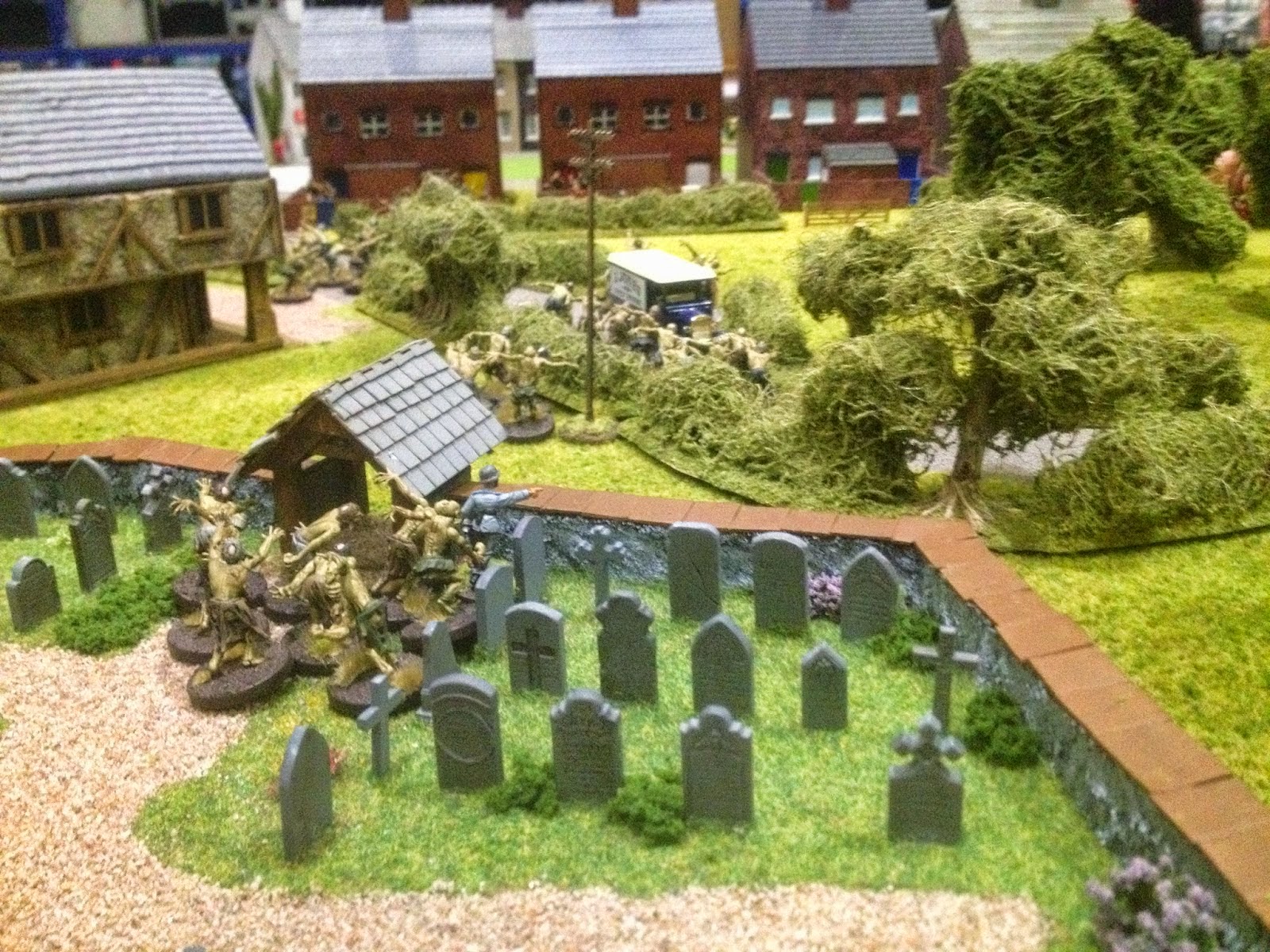
Alley's of Distraction gives us a better view of that TFL game, which surprisingly included zombies

Level 2 writes up his participation in this Glorantha adventure game

Meeples and Miniatures does a good tour of some display tables, including this gorgeous one from 4Ground along with Too Fat Lardies and Gripping Beast

JimBibblyBlog is proud of his samurai table, and with good reason he won the Best Trade Game there

I've omitted all the swag posts - those are far too dangerous to my credit rating!

29 January, 2013

Interview with Warwick Kinrade


This interview originally appeared in The Gazebo. Warwick Kinrade is the author of BattleGroup Kursk (BGK), reviewed elsewhere in issue #3.


DMC: Can you tell us a little bit about your background as a gamer? What early wargames influenced you or even inspired you to write your own rules?

WK: Early gaming for me was World War II and Napoleonics using Airfix and Matchbox kits, mostly on the bedroom floor. They were the first games with toy soldiers we had rules and dice for, before that we rolled marbles at each other’s men. Like many back in the 70s, most of my boyhood toys were army related, like Action Man, and mostly WWII too.

As I got a bit older I bought the first Warhammer rules, and we started playing them. Collecting actual army’s developed from there, and I was pretty much a fantasy only player throughout the late 80’s. I rediscovered World War II in the mid-nineties, with the first Rapid Fire, and we played them a lot. I started really collecting seriously then, boards, terrain, models, tonnes of stuff. That led me back into the wider world of historical gaming again, back to my youth, and I started collecting for other periods too, but WW2 always remained my main passion.

I don’t think I’d call it inspiration, but it was dissatisfaction with most of the WW2 rules available (and I tried most of them), that led me to write my own. Like many people, I figured it was the only way to get the game I wanted to play.

DMC: Before Kampfgruppe Normandy I think it’s fair to say not many historical wargamers would have heard your name – can you give us an idea of how you got into writing gaming material professionally?

WK: Well of course not, if you work for GW for 15 years then that is bound to be the case. I was also a games writer, in my teens I wrote many role-playing games, boardgames and house rules for everything. In some ways I think I preferred it to actually playing. I was taken on by GW after I left university (you know, when you suddenly have to get a job), so I applied with some of my own material, got an interview, did it and got a job as a trainee. After that I worked for GW in all sorts of writing and book production related roles, on White Dwarf, for the Black Library, etc. In the end I was Forgeworld’s main writer for 10 years. I guess there something inside that just needs to get out, given free time I often start noting down ideas of new games, I have hundreds of them. Some may someday see the light of day.


DMC: Is there any aspect or mechanic that you find yourself returning to across different games? Is there a common thread running through Warwick Kinrade material?

WK: Despite writing for 15 years, I haven’t actually designed many game systems. GW doesn’t do many anymore, so the opportunities were rare, but I do have certain things which I always consider when designing a game. After 30 year’s experience my ideas of what makes for a fun tabletop miniatures game don’t change much these days.

One important element, often overlooked, is that priority has to go to a gamer’s miniatures collection. Playing games is just part of the hobby, collecting is another big one, and I what to write games that encourage collecting, and give a reason and direction to it. For example, non-combat units like ambulances or radio teams. I wanted one (not loads just one of each) in my WW2 armies, and I also want them to do something in the game too, other than just look pretty. It doesn’t have to be much, just a little something useful. I’m not interested in making stuff powerful on the tabletop which, in my experience, is usually a fairly cynical attempt to boost miniatures sales and shows no respect to the players. Believe me it happens a lot, and there is a lot of ‘sales’ pressure, especially in the corporate world. I believe in the end, if the game plays well and is fun, people will want to buy the models anyway, you won’t need to twist their arms (by twisting the game). But you need to design a game from the ground up with collecting in mind, not shoehorn it in afterwards.

Another important aspect of wargames which I’ve come to love more and more is unpredictability and ‘chaos’ (not the spiky men). Games that roll ‘buckets of dice’ are quite predictable, because the more die you roll the closer you’ll get to the predictably average result. In my opinion, rolling 1 or 2 D6 is inherently more exciting than rolling 20, because the result is so much more random. There is nothing better than needing a 6 and getting it!


DMC: Looking at BGK, it’s clear that you’ve put a lot of thought into both points systems and scenarios. There seems to be great dispute between those two camps in gaming – what’s your take on the debate?

WK: My take is that both are valuable and valid. I do both. For years I was a purist, no points, only historical scenarios, I wanted a backstory and unbalanced but ‘correct’ forces, but I think this was because the points systems were overly simplistic and in striving for balance made the games dull. BGK points system exists to facilitate quick, evening gaming (because that’s what many players can do – including me), and the game doesn’t balance solely on points. More important is the Battle Rating system which works alongside it, it this system on which the game really balances. I also think the introduction of better, more historical-based and characterful army lists helps a lot to improve points-based games. You can have it both ways!

DMC: If all new sets of rules fulfil a need, what will BattleGroup Kursk (BGK) provide that other rules do not?

WK: A tenser, more dramatic and ultimately more fun game, which retains a good feel for the theatre or period! Subjective opinion I know, but I really think it provides a better feel for WW2 battles, and the character of the fighting in that theatre (here Kursk), than generic rules which provide effectively the same battles put with different model tanks. Of course, you can play like that, but I strive to give the games a characterful edge, a feel for the theatre and period, so battles in 1943 at Kursk feel different to those say, during the invasion of Germany in 1945. Not just the equipment has moved on, but the tactics, and the strategic situation too, I like to get a little of that influence into the army lists too. Subtle changes sometimes result in a very different feel and approach by players. It gentle encouragement though, not brow-beating.

DMC: Can you give us an example of how the German and Russian forces work differently?

WK: Well, the Germans are the all-rounders, a forgiving army to play, they don’t really lack for anything. Their infantry is good to very good, there artillery likewise, their tanks are good to superb, they have descent air support. All the elements are in place, and with good command and control they are a formidable outfit. Really, they were the easy part to deal with. It won’t be so in the 1945 supplement.

The Russians were the headache - now to make the Russian army fight more like a Russian army with its very different tactical doctrines? Obviously their equipment is cheaper, and their infantry is generally poor (but again very cheap). They have a lot of artillery, but it is inflexible, lots of guns, but can you get them in the right place at the right time. But it is command and control that they suffer most. Finding the balance took a while, but I think we cracked it.

Historically the Germans achieved about an 8-1 tank kill ratio at Kursk, and lost! But I don’t think you can write that game, who wants to lose that badly every game. But you can write a game were a 2-1 or 3-1 is the norm, it feels right, and yet the Russians can still win despite those heavy losses.


DMC: How do you handle the challenge of maintaining historical accuracy and playability at the same time?

WK: Basically, playability is always the priority, without it you have nothing. All the accuracy in the world doesn’t make for a better game. When designing you can take a few licences sometimes, as long as it improves the game play and retains the right feel. So, if a vehicle doesn’t have exactly the right move distance it won’t matter too much, as long as it still feels fast or slow.

That said, I try to get things right, and do a lot of reading and research. I’ve read everything I could get my hands on about Kursk. Most of it isn’t much use in games design, but it all feeds in on one level or another. Mostly, I want the tanks to have the right guns and armour.

DMC: I’ve described as ‘striking gold’ situations where rules reward historical tactics with success – do you have any good examples of this from playtests of BGK?

WK: Many. Too many to list. I’d like to think the entire reason for creating the game was to get closer to this, and I think we have succeeded (but that’s probably for others to judge). The number of reckless Russian T-34 charges that have had the German players cursing and sweating, only for a single Tiger to reap havoc and save what looked like a lost cause, or for a swirling melee to come out in the German favour, I’ve lost count of. Such asymmetry in a game is a tough one to balance; most games don’t even try and fudge it instead.

The game is inherently unpredictable, but it does encourage ‘realistic’ play. Note ‘encourages’, it doesn’t dictate it, I hate that, games and army lists with only one plan, based on what units you take, rather than how you fight with what you have.

DMC: I understand that you’re planning on doing Normandy ’44 and the Fall of the Reich ’45 next. What plans do you have for 2014 and beyond?

WK: Vague. The whole war (and beyond it too) are up for grabs. Obviously North Africa looms large, and there are many early war gamers I’d love to get something out there for. Blitzkrieg 39-40 isn’t my personal bag, but it will be high on the list. Best not to get too far ahead of yourself though, I try to stay focussed on the project in hand, pour all my efforts into that. I can say we won’t be dealing with the niche theatres and conflicts before we’ve covered the big ones. So there will be no Battlegroup ‘Norway’ or Battlegroup ‘Greece’, before I have covered early, mid and late war on the east and west fronts, North Africa and the Pacific. That’s a lot of work already. Spreading beyond WW2 is also on the cards, eventually.

DMC: Will these theatre-level books have the rules in them? How do you deal with comments about obliging people to buy the Kursk book to play with entirely different armies?

WK: The rules won’t be in every book, only the lists, scenarios, special rules etc. In effect, when you buy Battle Group Kursk you are buying the core rulebook and the Eastern Front 1943 supplement in one volume (which is not bad for £30). Soon(ish) (but don’t hold me too it), I’ll look at getting a smaller core rulebook available. But for now it’s Kursk, and I choose it because, as far as I’m concerned, the appeal of WWII wargaming is playing battles with the tanks (at its heart). So where else to start but at the largest tank battle ever?

23 January, 2013

BattleGroup Kursk - Review


The Plastic Soldier Company (in association with Iron Fist Publishing) has released a new games system for re-creating battles around Kursk in 1943 on the Eastern Front. They are written by veteran games designer Warwick Kinrade.


Overview

The book – well over 200 pages of colour – is split up into five broad sections:

  • 50 pages of rules with an example of a turn, and then detailed sections on movement, combat, artillery, morale and some special rules.
  • 25 pages of well-researched historical background (including information on the orders of battle and an in-depth timeline). 
  • Four detailed army lists including German panzer and infantry divisions facing Russian tank corps and rifle divisions, with full rules for all their equipment.
  • There follows 10 pages or so of generic scenarios and then a short seven-part campaign, ‘The Inglorious 12th July’, set during the savage tank battles at Prokhorovka.
  • A well-balanced modelling and painting guide – The tutorial shows three stages of painting… Basic, Gaming and ‘Master’ so while useful for novices, there’s plenty for more experienced gamers too.

First off, we get some guiding principles from the author: on style of play (friendly cooperation), measuring distances and line of sight. A few more pointers on what you’ll need to play are include (this one is solely for the novices) along with a very nice view of a battlefield. I think this is the first ‘wow’ moment in the rulebook: most wargamers would travel quite a way to play on a board like that, and tips on how to make such terrain are promised for later.


Then we start to get some idea of the structure of the game: army lists, points and battle rating (a factor which will be very important later), a discussion of infantry basing (single or multiple are fine, so long as individual casualties can be recorded), and a brief note on game size (minimum, maximum and typical points for games from platoon to battalion along with the recommended table size for each.

The Rules

I’m going to give a brief summary of the main parts of the rules along with a bit of analysis of the most important aspects. Pinning and morale play pivotal roles in the game. Supply and communications are also important considerations.

Command and Control

Each turn a commander can issue a certain number of orders (from 1D6 for a squad-level game to 4D6 for a battalion-level game, modified by the number of officers in play). A unit can take one action a turn, a list of orders is available, from straight-forward options like moving and firing, moving at double-rate and so on; to more specialised ones, like resupplying or requesting artillery fire.
Units can also be given a reaction order, which allows them to move or fire during a future turn in response to an opponent’s action.
Senior officers can also attempt to remove a pinned marker from a unit. If a player wants to un-pin multiple units he must draw a battle counter, which allows him to remove D6 pinned markers at the end of the turn.

Movement

Movement is fairly simple; infantry move 5” whether off-road or on one, only reducing this when crossing dangerous terrain (like barbed wire or minefields). Other units move further on the road, but most will lose D6” if they cross any obstacle or enter terrain.


Firing

Weapons have a maximum range, varying from 30” for infantry units with rifles to 70” for long-barrelled guns. All fire is made with D6s, and generally speaking a ‘6’ is an effective hit, a ‘1’ an outright miss and anything else a pin.
There are two main choices in the type of fire along with a few special rules:
Area Fire (for infantry and high explosive shells) – good for pinning the enemy without causing any casualties; it’s even possible at short ranges for a large amount of infantry fire to pin an armoured vehicle. Depending on the amount of cover the unit is in, it might not be pinned.
Aimed Fire – represents the unit spotting the target and actually hitting them for effect; an observation roll must be made (easier to spot vehicles than infantry, and easier to spot units in the open and firing than those obscured) before rolling to hit. After that the target unit can roll for its cover and then makes a morale test if it’s taken any damage.
There are rules to differentiate high explosive and armour piercing rounds (weapons have a penetration value and armour a rating – there’s a simple chart for cross-referencing). One old-school curiosity is the necessity to specify what ammunition load each of your tanks has at the start of the game; every time your fire you choose what type of round is being used – once you run out you have to be resupplied from a supply truck.
There are some further specialised rules for infantry falling back under attack, close assault and even anti-tank grenades. I really like the rules for these, rather than shoe-horn the normal shooting rules into this unique situation, there is a D6 table to determine the effectiveness of the attack.


Artillery

Artillery fire is a little bit more complicated in terms of mechanics, but I think how to treat the big guns is always a problematic aspect of wargaming rules. Because artillery is such a big part of the second world war (causing a majority of ground combat fatalities and wounds), balancing dominance with power is a tough ask.
Scheduled artillery arrive on a specified turn and location with no roll, but otherwise artillery from the ‘Additional Fire Support’ section of the list (representing army-level assets behind the lines) then a priority check must be made. If the roll fails, then HQ has refused your request; if the assets are directly under your battle group’s command you skip this part and go straight to the communications check. If that check is passed, deviation is accounted for and then we roll to see what the artillery effect is.

The rules escape one of the most common pitfalls by inflicting direct hits and pinning hits separately, moving from the centre of the blast area outwards, so that units closest to the epicentre will most likely feel worst off. Hit are applied until there no units or hits left (units can be subjected to multiple hits if there is an excess) so again there’s a decent chance that a significant number of units will be affected.

We get some additional rules for pre-registered target points, timed barrages and counter-battery fire missions, as well as a couple of good examples of artillery in action. We also see a detailed note on Soviet artillery, specifically picking out areas in the army lists where the Soviet flavour is (some are limiting, and some are definite pluses).


Morale

Morale is an important factor in the rules, with two aspects: unit (whether it will stand and fight) and battle group (who wins the battle).

Infantry units test whenever they take losses, but vehicles will take a morale test whenever they’re hit. There’s a chance that crew will abandon their vehicle is they were already pinned, immobilised or near an enemy unit without support. If the unit aces their test, they have a chance to go ‘Beyond the Call of Duty’ and immediately be given an order, even unpinning them if they are already pinned.

The battle group system is more complex. Each unit in your battle group has a battle rating (abbreviated br.). This represents how important and/or effective it is in the battle group. You can calculate your battle group’s break point by counting up your units’ total battle rating.

There is a mix of battle counters, most numerical (from 1 to 5, but clustering in the middle) but some with special effects. Each time your opponent destroys one of your unit you must draw a battle counter. More counters are drawn the first time your force comes under flame or air attack, whenever a senior officer is destroyed or when your enemy captured an objective. The extra battle counters include air attack, mine strike and others which allow you to strike back against your enemy. So it’s not all bad!

One really interesting feature of the rule (hinted at earlier) is the rally option at the end of each turn. You decide if you want to unpin (1D) unit in return for drawing a battle counter. This forces the player to make an assessment of the danger of his battle group breaking, and how important the currently pinned units are. There’s also an element of risk involved. When the number (hidden from your opponent) on your drawn battle counters exceeds your side’s battle rating, the game is over.


Special Rules

There are a slew of rules for specialised units, from the mundane (medics, artillery spotters, supply trucks) to the peculiar (bomb dogs). A few piqued my interest immediately. Radio trucks, wire teams and dispatch riders help you make those communications check to call in artillery, some give you a simple re-roll, but the dispatch rider gives you an automatic success as he rides off!

Some units are classified as ‘scouts’ whether they be a foot patrol, armoured car or spotter plane. Scouts help you win the initiative during the first turn of the battle and whoever has less scouting units than his opponent takes one battle counter in the first turn.

Also incorporated are rules specifically modelling mass Russian infantry wave attacks and tank assaults, as well as the strict authority of the NKVD.

The Army Lists

On first look the four army lists present a bewildering array of choices, but they are carefully structured so that you must purchase some basic units before going on to pick up the more specialist options. For instance, in the German Panzer Division list each standard tank option you pick allows one from the specialist support units; and given that a single Tiger I represents one such specialist unit, you may hobble yourself if you concentrate on non-standard units.

Within these constraints it is possible to pick a highly individual list, so I think this represents a good balance between historical accuracy and player style. Every possible option would seem to be available, from assault pioneers with flamethrowers and panzer aces to mass Katyusha batteries and motorcycle & sidecar combinations.


Conclusion

I’m not going to cover the painting guide or scenarios (I haven’t played them) except to say that they seem to be well chosen. The setups and forces involved varies in terms of size and style so I imagine most gamers interested in the period will be able to pick out one to try straight away.

While some don’t believe it should be a factor in choosing a wargames set, this book is definitely pushing the needle on the eye candy scale – while there are some historical images, the miniature photographs stand out for me, it seems like just about every unit you can field is represented in miniature form in the book.

I have to give these rules a solid thumbs-up: while I’m not crazy about keeping track of ammunition for each tank on the battlefield, the design principles are clear and implementation well-applied. I’m especially impressed with the battle group rating mechanic and trust that we’ll be seeing a lot more radiomen, supply trucks and other oddities on the battlefield due to the rules encouraging their use.

01 August, 2012

With Swallow's Wings

Put in a few orders a couple of weeks back, and all three of them arrived inside a week (from England). That's about how long it takes for packages to arrive and so this means that they were all sent the day (or maybe the day after) I submitted the order.


KR Multicase
I must admit I was a bit confused by the product selection procedure on the site, I sent in a comment (clicking on 'Contact Us') and received some very helpful advice.
If you're interested, I got the Kaiser (1) bag, with a Card case, 1xD2H (pick out foam for vehicles) and 6xM4H (to carry 150 troops) - perfect for a 20mm force.


Caliver Books
I've ordered from Caliver plenty of times before, so this was no surprise - still I was pleased when the newest ImagiNation campaign book from Messers Grant & Olley dropped in the letter box. The Wolfenbuttel War: Four table top teasers based on the Waterloo campaign.

Ainsty
My first time ordering from Ainsty, I chose a selection of wooden jetty pieces for my Perilous Trail game at Gaelcon in October

Excellent service from all!

24 April, 2012

Battlegames vs. Wargames: Soldiers & Strategy


The other article I wrote for #1 of The Gazebo is this comparative review of two wargaming magazines: Battlegames and Wargames: Soldiers & Strategy


Though the quantitative comparisons tell their own powerful story, that can’t be all there is when contemplating a magazine subscription. There are a few major differences evident between the two magazines.

Editorial Overview 
Battlegames, well into its sixth year of publication has a strong editorial voice in Henry Hyde. Published articles all share a little of his ‘old school’ outlook, though this doesn’t prevent fantasy or science fiction material being covered. That Henry’s professional background is in design lends an organic connection between the magazine’s content and its layout and photography. Battlegames nearly went under recently and the last three issues have been published by Atlantic Publishers – though this doesn’t appear to have impacted on the editorial policy at all.

Wargames: Soldiers & Strategy is younger than its current issue number might suggest. Prior to #54 it was owned and run by completely different people (in fact it was a Spanish magazine). As an editor my impression is that Guy Bowers is still finding his feet. Some design elements have been tweaked since the first few issues, for example the two guest columns had darker backgrounds and italic text and were actually relatively difficult to read; that problem’s been fixed.


Quantitative Comparison - Content


Exactly where the dividing line between a Historical Overview and Scenario lies is probably up for debate, though in broad strokes I think you get a clear picture. Where an in-depth playtest of rules systems has been done, I’ve tended to categorise it with Scenarios, Rules etc. rather than with the standard Reviews.


Quantitative Comparison - Price


I’ve converted everything into Euro for easy comparison (but Sterling prices are given below).

1.  £34.50
2.  £40.50
3.  £19.50


Qualitative Comparison

Articles


Battlegames has established a pattern of articles, with the well-developed scenarios of Tabletop Teasers written by wargaming doyen C.S. Grant giving way recently to the Command Challenges. These are written by a variety of authors and are more diverse in style, so far covering such dissimilar eras as the Western Desert of 1940-42 and the Great Northern War 1700-21.
Other articles can include general wargaming issues (like Chronological Relocation for Scenarios from #27 or Rules and the Eclipse of Generalship from #26). One recent three-part series following a campaign set in 18th Century fictional nation of Grenouisse is well worth a look. There’s usually a scenario or two and an in depth or comparative review which along with a regular feature on modelling projects and the usual reviews to round out each issue.

Wargames: Soldiers & Strategy pursues a different tack, with a theme for each issue (a holdover from its previous incarnation). These run the gamut from niche interests (The Glorious Revolution of 1688 and 1920s Pulp) to more mainstream (Napoleonic Wars and American Civil War). One very useful article in the theme is an overview of suitable miniature lines for the era.  The theme comprises a handful of articles (between four and six), so while it’s a common thread there are as many articles in the issue about something else entirely. An extra couple of scenarios and some modelling articles make up the rest. One aspect of the editorial approach is strongly seen: there’s often quite a lot of historical background in the articles. Worthy of specific mention are the regular columns by well-known games designers Rick Priestley and Richard Clarke.
One note on the reviews; the editor’s quite generous with the space allowed, being half a page for miniature/book reviews or a full page for a game, with a photo or cover image. In Battlegames it’s a tighter arrangement, with three columns of heavy text broken up with the odd image. The Wargames: Soldiers & Strategy approach makes for easier reading and easier searching, but I’m not sure that there’s more content (and I’m not counting words!).


Breakdown
While the quantitative table counting pages of articles is useful (I hope!) a description of the contents of the latest issue may be easier to digest.

#28 of Battlegames contains two modelling articles (making fields and useful tips for the painting novice); two scenarios (French and Indian War and the Napoleonic War); a guide to wargaming A Very British Civil War and the dramatic climax of the Grenouissian Intermezzo.

#59 of Wargames: Soldiers & Strategy contains six articles on the theme of the Viking invasion of England (a brief history, a campaign outline from the Siege of York to the assault on Wessex, a campaign system for Saga, a stand-alone scenario and an overview of suitable miniature lines for Dark Age Britain); three modelling articles (Viking diorama, Napoleon’s Hanoverians and using ‘The Dip’ aka Army Painter’s Quickshade); two playtests (War & Conquest and Point Blank); two scenarios (Pyrrhus vs. Spartans and Anglo-Dutch naval warfare). An interview with the Field of Glory: Napoleonic team and the two regular columns (Rick Priestley on ground scale and Richard Clarke on unit scale) complete the issue.

Brief Highlights

In #25 of Battlegames Jim Purky guides us through his decision to concentrate on Napoleon’s campaign against Prussia in 1806, and how he came to such a restrained (compared to most of us) outlook on wargaming. He goes through unit size, basing system, army makeup and figure availability.

In #55 of Wargames: Soldiers & Strategy Richard Lloyd writes a step-by-step modelling guide on making sabot bases whereby single-mounted figures can easily be mounted on a good-looking movement tray, one where they’re not too regimented. This one will definitely be take out at some stage over the summer when I have some leisure time for a project.

Quibbles

You certainly can’t fault Henry Hyde for being passionate about a heartfelt cause – he gives a page every issue of Battlegames to highlight his Combat Stress Appeal which supports a helpline for the military community and their families in the UK. With the page count of articles relatively low already it probably represents the only criticism which could be levelled at the magazine – though you may guess I find it difficult to reproach Henry on this front.

One surprising aspect of Wargames: Soldiers & Strategy is the amount of history which is included in articles. Sometimes this is a short introductory piece to a scenario or the initial article for the theme section. Other times however it seems to overwhelm the wargaming aspect of the article altogether. For example, in #56 there is a four-page article on naval wargaming in the Wars of the Roses – we get to the last page of the article before we have a short section on figures and ships and another paragraph on available rules. This is a little infuriating and barely represents a kick-start for the aspiring wargamer.

In Summary

When it comes down to it my quibble with regard to the amount of history in the magazine just isn’t a strong argument against the magazine – there’s plenty of good wargaming content there too. Wargames: Soldiers & Strategy beats Battlegames hands-down in terms of value for money, but at the end of the day both represent good value for a wargamer with broad tastes. €6/€8 a month gets you both and to my mind that makes a lot of sense. I renewed my subscriptions to both of them in the last few weeks.

Wargames: Soldiers & Strategy is published bi-monthly by Karwansaray Publishers 
Battlegames is published bi-monthly by Atlantic Publishers


The Gazebo is on Facebook & Google+

You can view and/or print issue #1 from here


If you want to join the attack email me.

18 April, 2011

Force on Force - Review

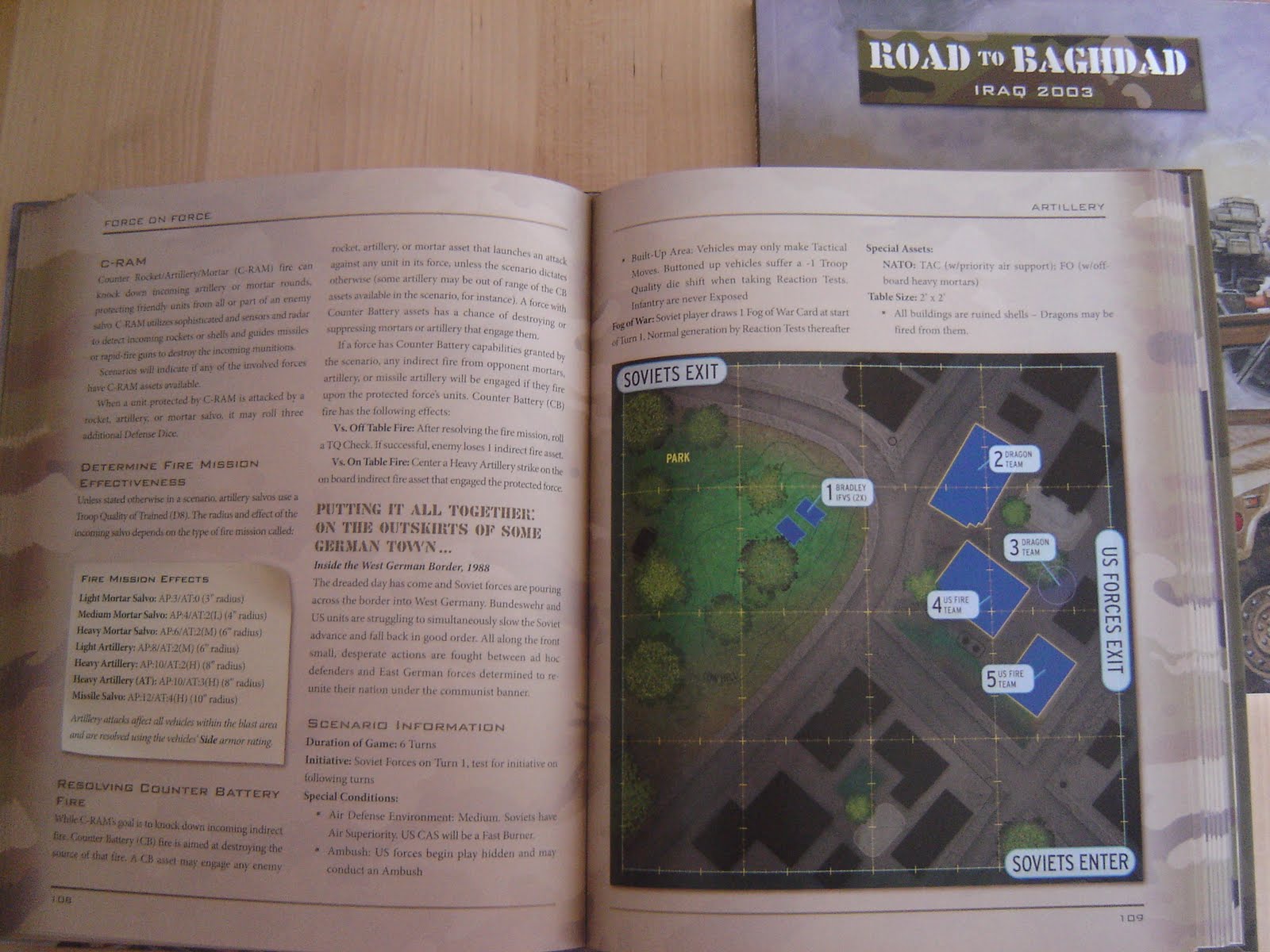
I pre-ordered this back when it was first listed at the start of the year, and it finally got here on Friday (ahead of schedule). No surprise given Osprey Publishing’s involvement, but this is probably the single best-looking and professionally produced wargaming book I’ve ever had in my hands. I’ve been reading it straight through, as well as dipping in and out of it when I’ve had a few minutes over the weekend, and I must admit I am as impressed with the substance as I am with the style.


Style

A few early typos aside, there’s really nothing I can complain about on the production side of things, and there’s plenty I am pleased with:
  • Proper cloth binding (that’s hardback to you) which means this book will last and it will stay open on the table
  • Well laid out, with plenty of whitespace (the margins and such which make a book like this readable) but not so much that makes you feel like you’ve been cheated. Also, the headings, sub-headings and text boxes make it easy to quickly scan a page
  • A decent contents section and a good index are hugely important and often neglected – how often do wargamers spend five minutes looking for some rule they’re not sure about?
  • The art is just fantastic. A healthy mix of drawn artwork (from other Osprey books), photographs (from the frontline) and gaming miniatures in action.  

Substance

But who am I kidding; most of us do not buy wargaming rules just to look at the pretty pictures (even if that’s all we do with many of them!). One thing immediately stands out about the book:
  • Not only do we get a general ‘big picture’ introduction from Shawn & Robbie Carpenter at the beginning; but littered throughout the book are individual designers’ notes relating to single aspects of the rules. I really appreciate the insight into a designer’s head, both at the high level and drilling down to an individual decision.
For those who are not familiar with anything out of the Ambush Alley Games stable, a few pertinent points need to be made about the rules and the book in general:
  • The rules are clearly written, and we are in no doubt that a level of abstraction is intended. There is no discussion of the thickness of armour on a particular tank, nor the relative benefits of 5.56mm vs. 7.62mm ammunition.
  • Linking to that aspect, the fact is that these rules are outcome-driven and not process-driven. The quality of the troops is crucial and the tactics utilised vital. The player doesn’t make decisions which his alter ego on the battlefield (typically the platoon commander) wouldn’t.
  • The quality of troops is modelled by the use of different die-types. From D12 for very rare über-soldiers, to D6 for badly trained militia and such. Troops have a score on a similar scale for morale. Depending on the circumstances more dice may be thrown but typically the outcome is determined through opposing die rolls.
  • Battlefield friction occurs primarily through Fog of War cards, which may be viewed as a random events deck. When things heat up, unexpected things happen.
  • The rules are built up from the most basic principles into more complex facets (like vehicles, or asymmetric engagements) and each time an extra aspect is added there is a small scenario to demonstrate
  • In an asymmetric engagement scenario balance comes from a different set of victory objectives, even though the forces involved may be wildly different in behaviour and quality

For those who have encountered the system before, is there any reason you should buy this book?
  • Since first published in 2006, Ambush Alley has undergone some big changes. Extra rules have been added, the scale of the game has increased and the prospect of regular forces clashing has come into it. This edition represents the definitive clean-up of the sprawling game engine.
  • As well as that, a lot of things have been tightened up. A lot of games have been run over the last five years, and a lot of questions have been asked on the forum and it’s obvious that things that were clear in the small group are less so when a rule set is published and set free!
  • The vehicle rules are now more streamlined and easier to use. While tables aren’t for everyone, I can definitely say the new system works better.
  • There’s a very nice unit-driven campaign system in the book (which you may recognise if you bought the Vietnam supplement ‘Ambush Valley’. In deciding to just follow the platoon involved (or in tracking an insurgency develop) it’s avoided most of the bugbears of campaign wargaming.
In short for £25 (currently available on Amazon for just £15.19) this book is well worth it on all levels.

More like this